

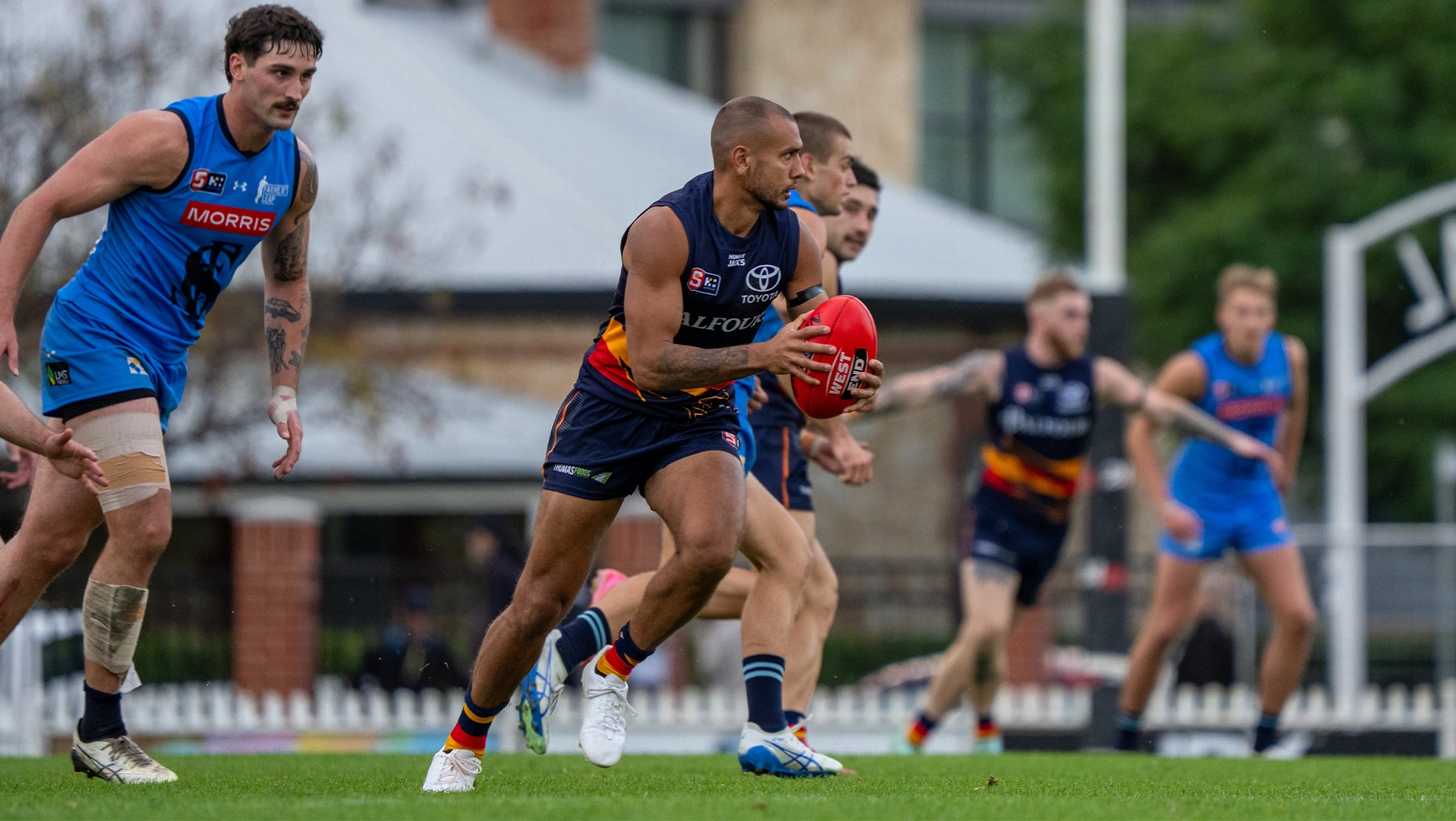
Professional sport has become very good at measuring physical recovery.
Teams track training load, GPS output, sleep, soreness, wellness scores, heart rate, and physiological markers to understand how athletes are responding across a season. These measures help staff manage workload, recovery, and readiness in environments where the margins are small.
But recovery is not only physical.
Sustained attention, reaction time, vigilance, and decision-making can also shift with training load, travel, sleep disruption, repeated competition, and psychological pressure. These changes are harder to observe directly, and they may not always be captured by the physical and subjective data teams already collect.
That is the focus of a professional sport project using the NeuroUX Fatigue Monitoring Platform, a PVT-based system for measuring cognitive readiness. The team is exploring whether Adaptive PVT-BA can provide a brief, low-burden way to track mental fatigue and recovery across a competitive season.
Objective
The goal of the project is practical: assess whether PVT-BA is useful in a professional sport setting.
The team wants to understand whether athletes can complete the assessment repeatedly without adding unnecessary burden, whether the platform is easy to administer across a season, and whether the data can add meaningful context beyond existing recovery and performance measures.
That fit matters. Professional sport teams already collect a large amount of information, so any new measure has to earn its place. It needs to be short, simple, technically reliable, and useful enough to support repeated use.
The study will look at PVT-BA patterns alongside existing measures, including subjective recovery data, physiological and physical monitoring, and existing 3-minute PVT-B data from prior work in a separate study. This comparison will help the team understand whether the adaptive version provides a useful applied signal in the context of sport.
What Is Adaptive PVT?
The Psychomotor Vigilance Test, or PVT, is a performance-based measure of sustained attention and reaction time. During the task, a participant responds as quickly as possible when a stimulus appears. The test captures indicators such as reaction time, lapses, slow responses, and false starts, and can provide a clear ready or not ready result.
PVT is widely used in fatigue, sleep, and vigilance research because it is simple to complete but sensitive to changes in alertness.
Adaptive PVT-BA is based on the brief PVT-B, but is designed to reduce testing burden further. The adaptive version can be completed in under three minutes as it adjusts the test duration based on the participant’s responses.If the data are clear earlier, the assessment can end sooner. If more information is needed, it continues long enough to support a clearer readiness estimate.
Adaptive PVT can also support personalized baselines for readiness, where an athlete’s results are interpreted against their own prior pattern to inform a ready or not ready signal. That personalized readiness workflow is not the focus of this study. Here, the team is first evaluating feasibility, utility, and how the signal relates to existing data.
How the Protocol Fits Into Athlete Recovery
The project uses repeated PVT-BA assessments through the NeuroUX Fatigue Monitoring Platform. It also includes a short subjective rating alongside the objective task. This can help compare how an athlete feels with how their sustained attention is performing at that moment.
That comparison is useful because subjective and objective signals do not always move together. An athlete may feel recovered while showing slower vigilance, or feel flat while still performing within their usual range. Over time, those patterns can help staff ask better questions about recovery, load, and mental readiness.
Why This Matters
This project is not about adding more data for the sake of it. It is about testing whether cognitive readiness can be measured in a way that is practical enough for professional sport.
If the assessment is too long, too disruptive, or too hard to administer, it will not fit. If it is brief, low burden, and useful alongside existing systems, it may become a valuable part of how teams study recovery.
The broader opportunity is a more complete view of athlete readiness. Physical load, subjective recovery, sleep, wellness, and physiological data already tell part of the story. A PVT-based measure adds another layer: sustained attention and vigilance.
For teams studying fatigue and recovery, that layer may help make cognitive readiness more visible. Not as a standalone answer, and not as a replacement for staff judgment, but as a practical signal that can support better questions, clearer conversations, and more informed recovery decisions across a season.
Explore Cognitive Readiness In Professional Sport
If you are studying fatigue, attention, or cognitive recovery in athletes, or exploring ways to add objective readiness measures to an existing recovery program, NeuroUX can support brief PVT-based assessments through its Fatigue Monitoring Platform.
Reach out to learn more about the NeuroUX Fatigue Monitoring Platform.
.png)


